Another company had already been out to clean the chair. A week later the dye was still there, and that's when this homeowner called us.
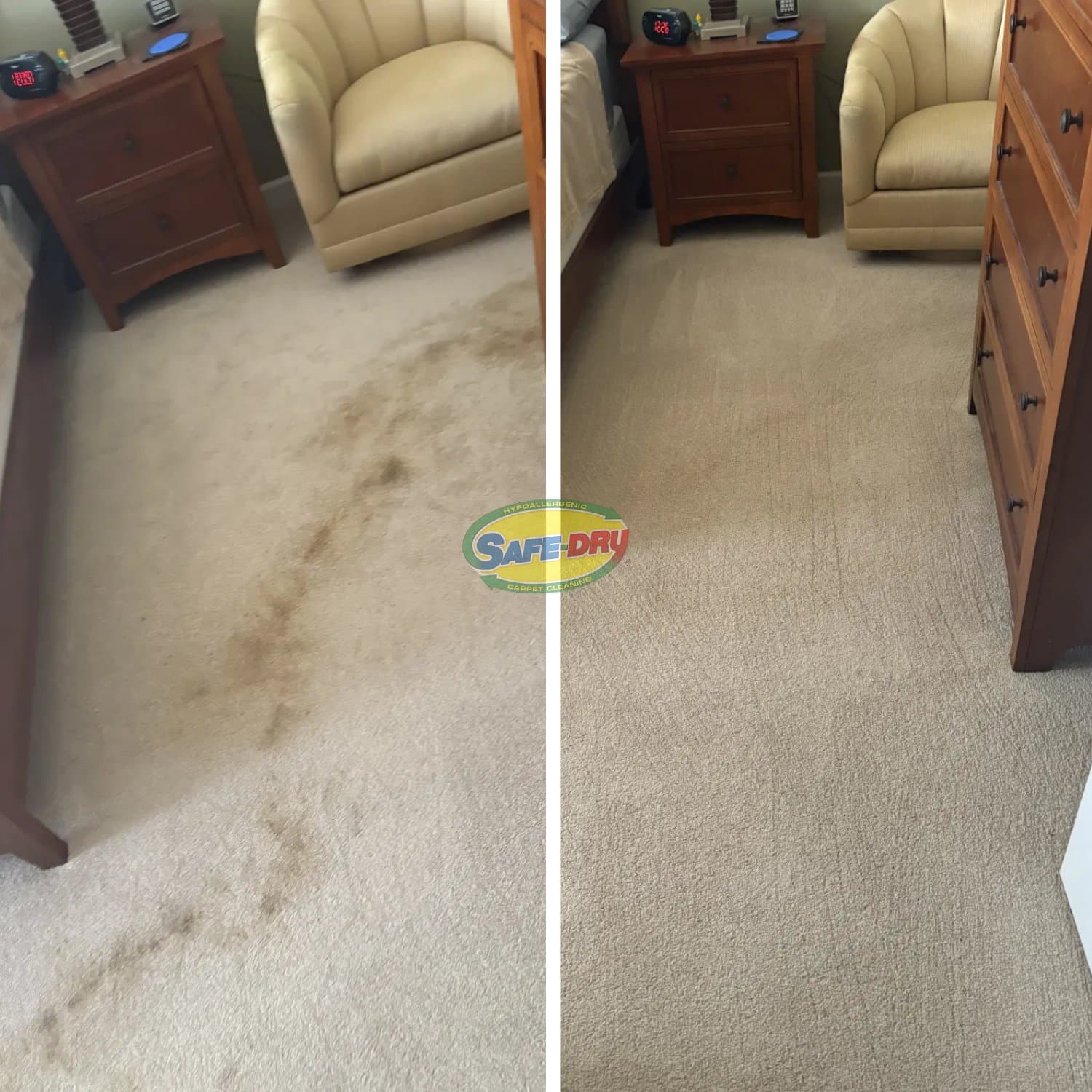
The chair was light-colored, and clothing dye had rubbed off onto it. That was problem one. Problem two was a high-traffic stretch of carpet that had gone dingy. Problem three was a handful of printer ink stains from an accident about three years earlier, plus a few other nasty spots the customer had more or less given up on.
Why a failed first attempt changes the job
When someone has already paid to have a stain removed and is still looking at it, the second visit carries more weight. They're watching to see if anything will be different this time, and they're half-wondering if the chair was ever fixable. We don't take that lightly.
It changes the technical side too. Fabric that has been treated once may be holding residue from the first attempt, or it may be weaker, so the second pass has to be more careful. More aggressive is usually how chairs get ruined.
The chair
Clothing dye doesn't sit on the surface. New jeans, a dark towel, a damp shirt: the color migrates into the upholstery fiber until it looks like part of the fabric. On beige or cream, even a small patch catches your eye every time you walk into the room.
The usual first reactions make it worse. Household cleaners can set the dye or strip the fabric's own color, and blotting over and over with water tends to spread it into a wider, fainter ring that's harder to treat.
Justin, our tech, looked closely at the fabric and at whatever the previous company had left behind before he touched anything. Then he used a different technique from the one that had already failed, one that worked with the fabric and didn't try to force the dye out. It worked. The customer said so in their review, and that's the line we were happiest to read. Results like that come from slowing down on the assessment, not from stronger chemicals. Once the stain stopped drawing attention, the chair went back to being a chair.
The carpet: one lane and three-year-old ink
The main path through a room collects dry soil and body oils that vacuuming never fully gets out. The walkway goes dark long before the rest of the carpet does, and the whole room starts to feel worn even when it's well kept.
Ink is its own problem. It spreads easily and settles deep, and after three years a stain becomes part of the scenery. People stop expecting it to change. Spots like that turn a routine carpet cleaning into stain work, with each spot handled on its own and the traffic lane getting a full clean around them. We kept the water to a minimum and used nothing sticky, so the lane wouldn't pull dirt straight back into the same path a month later.
The room only came together once both were done. Clean the chair alone and you've fixed half of it.
If there's a lesson in this one, it's that a stain one company couldn't get out isn't automatically permanent. Method matters more than force. Old carpet spots deserve a second look too, especially the ones everyone quit on years ago, and a traffic lane changes how a room reads even when there isn't a single visible stain in it. Dye on fabric is still worth acting on fast.
Forest Acres has a Safe-Dry office of its own now, and if that's your address, they're closer to you than we are. For the rest of Columbia, and for upholstery or carpet stains somebody else already tried and failed on, choose a day on our online scheduler. In the notes, say what caused each stain if you know. Ink and dye call for different handling.